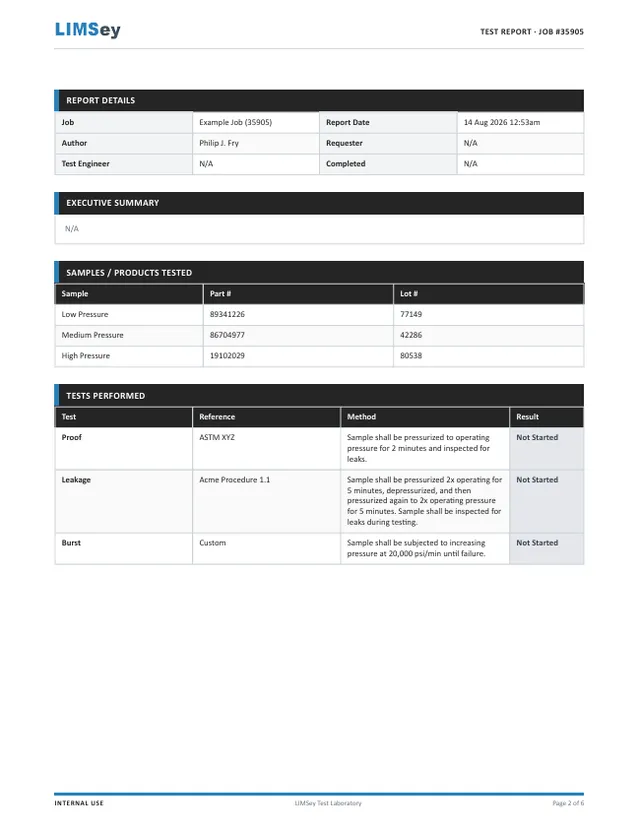
The Role of LIMS in Achieving Regulatory Compliance
Discover how LIMS enhances laboratory regulatory compliance and its role in streamlining workflows, ensuring data integrity, and meeting quality standards.
Proving 17025 compliance shouldn't mean days of hunting through folders. LIMSey is ISO 17025 software in the way that matters to an assessor: the records they ask for — calibrations, changes, training, corrective actions — stay organized as a side effect of running your lab.
Every change to data is automatically logged — who changed what, when, and what it was before. Your records meet traceability requirements without anyone maintaining a log.
Expiration dates, automatic out-of-calibration flags, certificate storage, and instant impact tracing when equipment fails its as-found condition.
Procedures and documents version-controlled and organized for audits and reviews — no more hunting through shared drives.
Link training to specific staff members, keep records current, and identify gaps before an auditor does.
Log issues, track them to resolution, and print completed corrective actions for auditor review.
Requester and lab manager reviews of testing — the steps 17025 requires — exist as explicit tasks in every job template.
“It was easily implemented and is easy to use. It is an indispensable tool to help our lab maintain ISO compliance. All your documents are in one location; test results, equipment maintenance and calibration records, corrective and preventive actions, and anything else you need for your auditors. It can be customized to your needs.”
ISO/IEC 17025:2017 doesn't require software, but most of its record-keeping clauses are painful without it. Here is where each one lands in LIMSey.
| Clause | What it asks for | In LIMSey |
|---|---|---|
| 6.2 Personnel | Competence and training records per person | Training records linked to each staff member, with re-training triggered by document revisions |
| 6.4 Equipment | Calibration status, records, and impact when equipment fails | Calibration expirations, out-of-calibration flags, certificates, and impact tracing to affected work |
| 7.5 Technical records | Who did what, when, and what changed | Automatic audit trail on every record, with the value before and after |
| 7.8 Reporting of results | Complete, traceable test reports | One-click PDF reports and the Report Builder, generated from the recorded results |
| 7.10 Nonconforming work, 8.7 Corrective actions | Log, investigate, resolve, and review | Corrective actions tracked to closure and printable for the assessor |
| 7.11 Control of data | Protected, backed-up, controlled records | Cloud-hosted with encryption, daily backups, and audit trails — see security |
| 8.3 Control of documents | Approved, current, version-controlled documents | Document control with revisions, organized for audits and reviews |
LIMSey is a LIMS built for in-house engineering and materials test labs at manufacturers, with these ISO/IEC 17025 records built in rather than bolted on — per-user pricing with every feature included, US-based, founded in 2016.
Discover how LIMS enhances laboratory regulatory compliance and its role in streamlining workflows, ensuring data integrity, and meeting quality standards.
How an ISO/IEC 17025 assessment actually runs — the lifecycle, what has to exist before the assessor arrives, the records they always ask for, how witnessed tests go, the most common deficiencies, and how to respond to the report. From labs that have been through it.
What ISO/IEC 17025:2017 actually requires of a testing lab: the five requirement clauses, the records each one generates, what changed from 2005, how it differs from ISO 9001, and where a LIMS carries the load — written by a vendor whose customers get assessed.
Book a demo and see how accredited labs stay ready year-round with LIMSey.